[CES 2026] Hyundai Motor Group - A Converging Vision of Robotics and Mobility
2026. 1. 13.
CES 2026

Hyunyoung Kim
Founder of Sphere D, a design and strategy studio analyzing global tech trends and product positioning.
This article is part of Sphere D’s CES 2026 Insight Series, where we analyze what is often overlooked: structure, positioning, and why products succeed or fail in the real market.
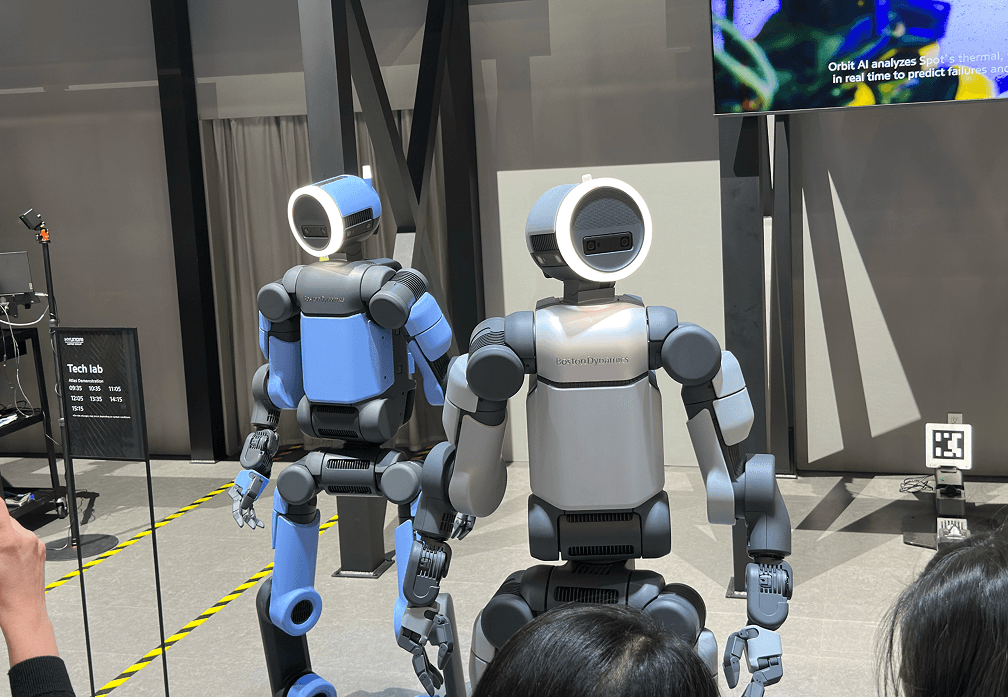
At the Hyundai Motor Group booth at CES 2026, one thing stood out immediately. The robots were not waiting to be explained. Most robots at the show still felt like demonstrations, but Atlas looked like it was already at work.
Developed in collaboration with Boston Dynamics, the new humanoid robot Atlas represents a transition from research to commercial prototype. Standing approximately 2.3 meters tall, equipped with 56 degrees of freedom, and fitted with human scale robotic hands embedded with tactile sensors, Atlas is designed to lift up to 50 kilograms and operate reliably in environments ranging from minus 20 to 40 degrees Celsius.
What makes Atlas compelling is not just strength or precision. When its battery runs low, it autonomously navigates to a charging station and resumes work without human intervention. It can learn new tasks in less than a day, operating within a fully autonomous learning and execution framework. Hyundai Motor Group has stated its intention to mass produce Atlas and deploy it across industrial sites, with reports already indicating that units will be introduced at the Georgia Metaplant in the United States in 2026 to support logistics and assembly operations.
From Assisting Humans to Owning the Worksite
The AI layer integrated into Atlas reinforces Hyundai Motor Group’s intent. Through collaboration with Google DeepMind, the company is applying Gemini based robotics AI to enable Atlas to interpret complex instructions and respond autonomously in unfamiliar environments.
This is where the strategy becomes clear. Hyundai Motor Group does not define robots as automation tools designed to replace isolated tasks. Instead, robots are positioned as operational agents capable of understanding context and adapting to real world conditions.
Robotics Is Already Embedded Across the Environment
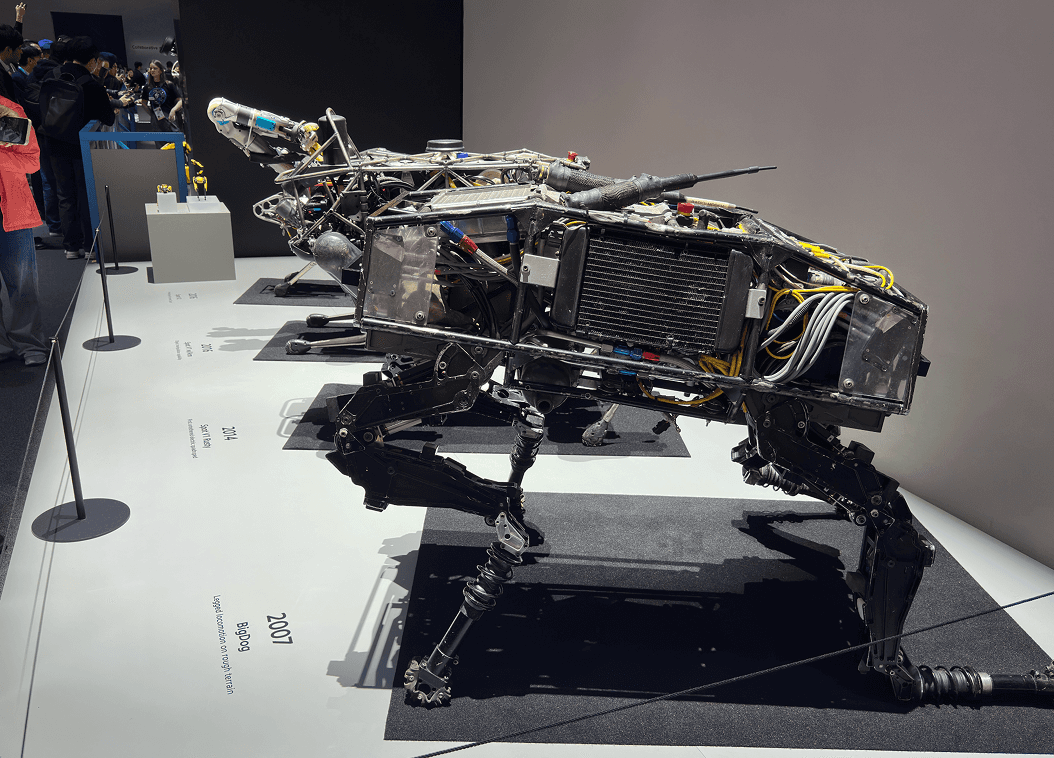
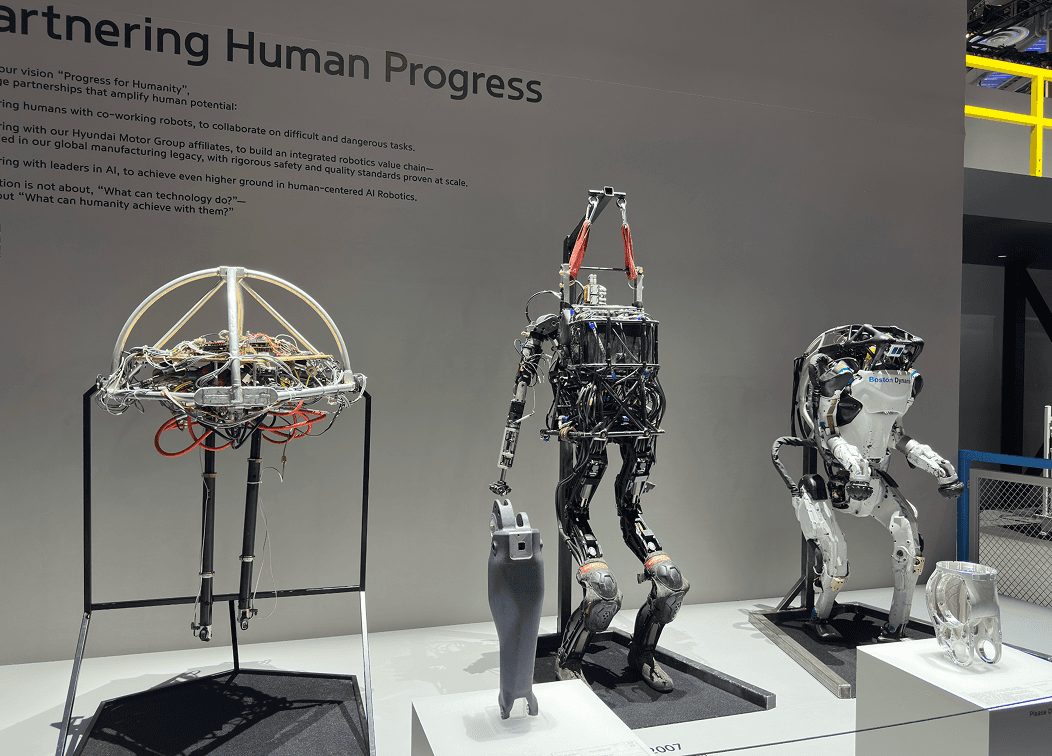
Looking beyond Atlas, the booth revealed a broader pattern. Robotics at Hyundai Motor Group is not a single initiative but a layered system already in motion.
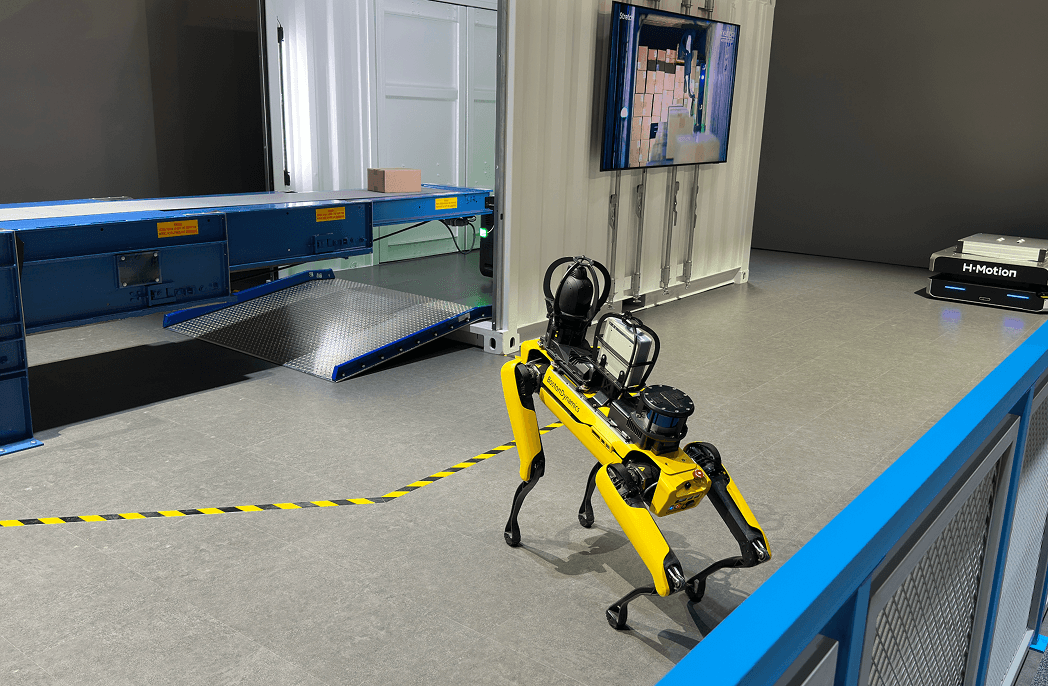
Spot, combined with Orbit AI, was demonstrated as a smart maintenance robot that autonomously patrols factories and power plants, detecting anomalies and collecting and analyzing sensor data.
MobED was presented as a multipurpose mobility platform that can be configured with modular attachments for indoor delivery, serving, and logistics scenarios.
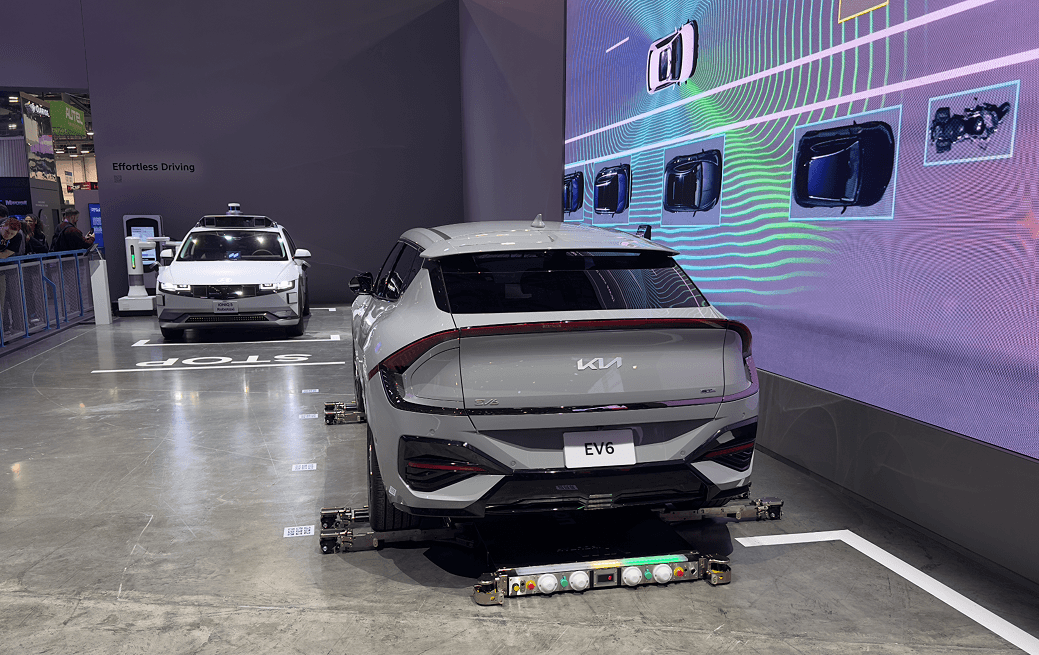
A fully autonomous electric vehicle charging robot physically connected a charging connector to an Ioniq 5 robotaxi, illustrating the final step toward unattended vehicle operation.
Collaborative robots and autonomous mobile robots demonstrated logistics transport, while the wearable robot X ble was showcased as a system designed to augment human physical strength. AI vision based inspection systems such as Spot AI Keeper further emphasized that Hyundai Motor Group is not building a single flagship robot, but an environment where robots are structurally embedded into work itself.
The Vision Was Announced Years Ago, What Changed Is the Stage
Hyundai Motor Group elevated robotics to a core future strategy following its acquisition of Boston Dynamics in 2021. At CES 2022, the company introduced the concept of Metamobility, positioning robots as a bridge between digital and physical worlds. Since then, investments have steadily expanded across industrial, logistics, and personal mobility domains.
What differentiates CES 2026 is execution. The vision has moved beyond proof of concept into operational readiness. Atlas received a top innovation award in the robotics category, and TechCrunch described the moment as a turning point where robots are no longer concepts, but practical collaborators.
The roadmap continues to extend. Hyundai Motor Group is exploring scenarios where robotic arms operate inside autonomous vehicles, where vehicles become mobile platforms for robots, and where robotics integrates into urban air mobility and smart city logistics. The convergence of automotive manufacturing expertise and robotics technology is now unfolding across the group’s entire portfolio.
What makes Hyundai Motor Group’s robotics strategy compelling is not how advanced the robots are, but how clearly their deployment is defined. These robots are designed for factories, not laboratories, for operations, not pilots, and as accountable actors rather than assistive tools.
This is design built around execution. At that point, robotics stops being a future possibility and becomes a strategy that is already operating today.
Sphere D.
Contact.
contact@sphered.kr
+82 70-8098-0775
Location.
Seoul, Korea
Toronto, Canada
Services.
Works.
Copyright © 2025 Sphere D. All rights reserved.
Sphere D | CEO: Hyunyoung Kim | Business Registration No.: 330-33-01418
E-commerce Registration No.: 2025-Seoul Seocho-0075
Address: 11F, 17, Seocho-daero 77-gil, Seocho-gu, Seoul, Republic of Korea