[CES 2026] Bodyfriend - Redefining the Massage Chair as a Healthcare Robot
2026. 1. 13.
CES 2026

Hyunyoung Kim
Founder of Sphere D, a design and strategy studio analyzing global tech trends and product positioning.
This article is part of Sphere D’s CES 2026 Insight Series, where we analyze what is often overlooked: structure, positioning, and why products succeed or fail in the real market.
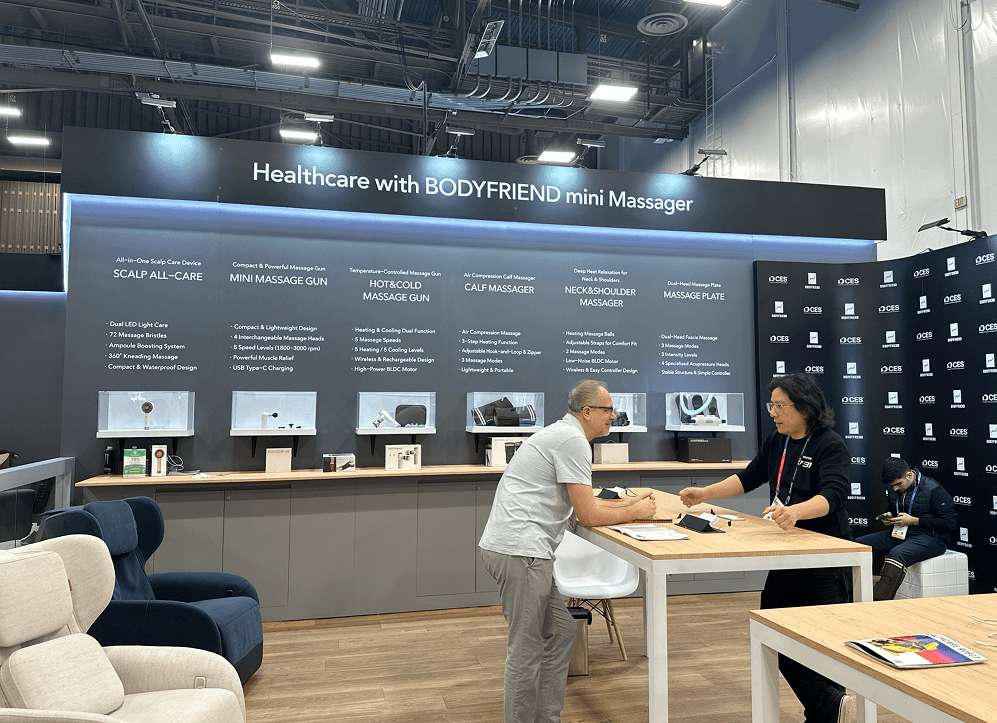
From Home Appliance to Robotic Healthcare System
At CES 2024, Bodyfriend’s booth stood out for one clear reason, scale of attention. More than 25,000 visitors gathered, forming some of the longest lines on the show floor. Among international attendees, one reaction kept surfacing, this no longer feels like a massage chair, it feels like a robot. As the market leader in Korea’s massage chair industry, Bodyfriend used CES to reposition its products not as premium appliances, but as healthcare robots. The company highlighted three core models, Phantom Rovo, Falcon, and Quantum, all designed from the ground up with robotics as the underlying premise.
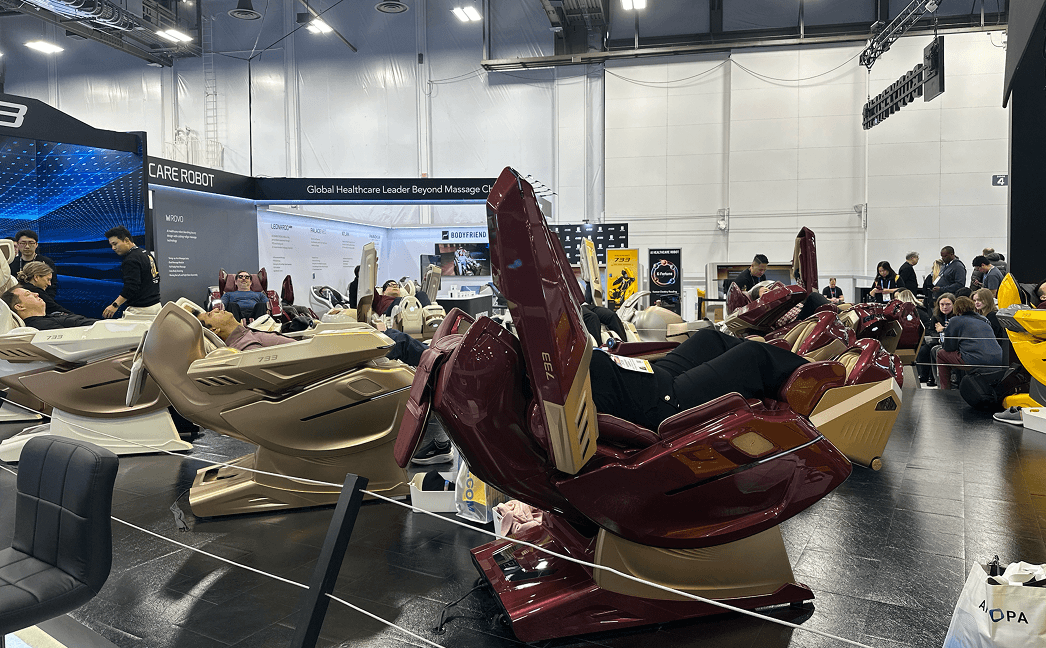
Where the Shift Began, Phantom Rovo
The turning point was Phantom Rovo, launched in 2022. It was the first massage chair to introduce independently driven left and right leg modules, enabling movements that traditional chairs could not perform. By controlling each leg at different angles, the system stretches deep core muscle groups such as the iliopsoas, gluteal muscles, and hamstrings. Motions that previously required human assistance were translated into mechanical sequences. Reclining the back while lifting one leg and lowering the other, or extending the hamstrings through coordinated joint movement, felt less like massage and more like robotic manipulation of the body. This was the moment Bodyfriend began referring to its chairs as robots, not metaphorically, but functionally.
Falcon, Robotics Adapted to Everyday Living Spaces
Falcon brought this technology into more typical homes. After validating the concept with Phantom Rovo, Bodyfriend preserved the same core robotics architecture while significantly reducing the footprint. The result was a second generation model suitable for mid sized apartments and bedrooms, without sacrificing independent leg actuation or advanced stretching programs. Leg movement speed was doubled, enhancing dynamic motion, and the product reached 18,000 units sold within four months of launch. This was not a simplified version of the technology, but a contextual redesign, adapting robotics to real living environments.
Quantum, A Flagship Push Toward Personalized Healthcare
Quantum represents Bodyfriend’s most ambitious statement. A multi year CES Innovation Award winner, the flagship model extends robotic stretching into mental wellness, incorporating brainwave based massage, relaxation programs, and AI driven automatic routines. The system analyzes body type and fatigue levels to adjust intensity, while real time heart rate data informs personalized relaxation sequences. With more than 3,000 components per unit and rigorous durability testing, including hundreds of thousands of air cell cycles and over 1,500 hours of motor endurance testing, Quantum clearly targets a premium segment. At this point, the product reads less as a massage chair and more as an in home personal healthcare system.
Market Response and Strategic Implications
Reactions at CES were immediate. Visitors described the experience as feeling guided rather than programmed, noting that the chair seemed to understand movement rather than simply repeat patterns. Major outlets including PC Magazine highlighted Bodyfriend as one of the show’s most compelling hands on experiences. Building on this momentum, the company announced plans to expand beyond chairs into massage sofas and beds, signaling a broader wellness home strategy.
Criticism remains. Some question whether the term healthcare robot overstates clinical impact, and others call for further medical validation of certain features. Yet the market signal is clear. By introducing robotics language and structure into a mature category, Bodyfriend disrupted expectations. Competitors have begun exploring similar approaches, and Bodyfriend’s roadmap, including collaborations with IT firms, bio sensor integration, and deeper AI personalization, suggests this is a sustained strategic shift rather than a one off repositioning.
Why This Case Matters
What makes Bodyfriend notable is that it redefined the market without abandoning its core product. The company did not replace the massage chair, it reframed it. By shifting the narrative from appliance to robot, and from feature set to functional role, Bodyfriend altered how customers and competitors perceive the category.
This mirrors a question many organizations face when revisiting product strategy. Is innovation about creating something entirely new, or about rearchitecting what already exists through a different lens. At CES 2024, Bodyfriend demonstrated how choosing the latter can fundamentally change market perception.


Sphere D.
Contact.
contact@sphered.kr
+82 70-8098-0775
Location.
Seoul, Korea
Toronto, Canada
Services.
Works.
Copyright © 2025 Sphere D. All rights reserved.
Sphere D | CEO: Hyunyoung Kim | Business Registration No.: 330-33-01418
E-commerce Registration No.: 2025-Seoul Seocho-0075
Address: 11F, 17, Seocho-daero 77-gil, Seocho-gu, Seoul, Republic of Korea